July 23, 2015 by katie
Directed by Katie Day
Text by Clare Duffy
Video by Chris Keenan
Sound by Mark Day
Scenography by Xristina Penna
Card Game Designer Holly Gramazio
Stage management by Xanthe Parker
Creative Technologist David Haylock, Watershed
Producer Thomas Wildish
Identity Design by Sebastian Harding
Scientific Collaborator Professor Debra Skene
Performed by Ali Belbin, Angela Clerkin, Rochi Rampal, Graeme Rose, and Magdalena Tuka
2015 Tour funded by Arts Council England, The Sir Barry Jackson Trust, and our Kickstarter supporters. Supported by Watershed, Theatre in the Mill Bradford, and Birmingham REP. Official 2015 hotel partners: Radisson Blu Birmingham & The Bradford Hotel.
Originally commissioned by Camden People’s Theatre, and funded by a Wellcome Trust Arts Award, Arts Council England, Birmingham City Council and the Sir Barry Jackson Trust, with support from Contact Theatre, CPT and mac.
Our thanks to the creative team and casts who played key roles in developing the original production in 2008.
by katie
An Evaluation Report of Black Tonic, produced in 2009 for the production’s principal funders the Welcome Trust, is available to download. Click here to download the Evaluation Report and Supporting Documents. This information is made available for the purposes of sharing our learning in relation to creating theatre that engages with science.


July 17, 2015 by katie
I was asked to give a presentation about how to run a successful crowdfunding campaign recently, and thought it would be a good opportunity to share some of the learning I’d accumulated through running our Black Tonic 2015 campaign earlier this year, and the research I did that fed into the campaign.
I thought I’d share a PDF of the slides here, so others could take a look too.

June 3, 2015 by katie
The Other Way Works is seeking an Executive Director
About the Company
The Other Way Works creates playful theatre that immerses our audiences in the story.
The intimate scenarios we create allow our audiences to explore places and perspectives anew, provoking them to change the way they live their lives.
We believe that the depth of an experience is as valuable as the breadth of people reached.
We are part of a new wave of theatre makers re-inventing the way people engage with culture, utilising new technologies and creating theatre out in the real world.
It’s an exciting time in the development of the company, we are about to re-tour our successful 2008 production ‘Black Tonic‘. Projects in development include ‘Agent in a Box’ a narrative game, and ‘Afterlife’ a creative retreat, and an expansion of our ‘Bandstand’ project.
A key aim for our organisation at this time is to speed up the rate of output and increase the reach of our work, by developing an effective, sustainable, and appropriately resourced operating model to enable this.
To make this happen, The Other Way Works is creating the new senior management role of Executive Director.
About the Role
You’ll work alongside Artistic Director Katie Day to lead and manage the company, working on strategy, organisational development and fundraising, as well as market development and administration.
We’re looking for an ambitious person who loves to make things happen, who supports and champions artists, who is looking for a new challenge at a company where they can effect change and growth, and who enjoys the variety of a workload that goes from strategy and networking to bookkeeping and answering emails. We want someone to join us, who wants to grow with us and build a future for the company that has them in it.
We have some money earmarked to support the role in a freelance capacity for the first few months, but we are clear that the key deliverable will be fundraising to support the Executive Director Role and finding a way to make this role sustainable in the long term.
Key Responsibilities as the role develops
– Building a package of income to deliver activity and support core staff fees/wages over the next 2 years, from mixed sources including Arts Council England, Trusts & Foundations, Research Councils, Consultancy, and Fees & Commissions;
– Opening up new markets for our work including: international touring & co-production; working with brands and other partners; expanding our consultancy offer;
– Taking responsibility for the good running of the Company, enabling it to be risky, ambitious & bold with its theatre work, and freeing up the Artistic Director to spend more time making theatre, delivering workshops, speaking, and mentoring.
Person Specification
Ideally, you will have:
– An interest in interactive and immersive theatre, and the integration of theatre and new technologies;
– 5 years experience of working in the UK Theatre sector, or wider creative sector;
– Experience of writing successful funding bids;
– Experience of driving strategic development in similar organisations;
– Demonstrable experience of setting and managing budgets;
– Good organisational skills;
– Ability to represent the company locally, nationally & internationally.
At the beginning we are flexible about how this role works in terms of location and number of days per week worked, but in the long term we would like the role to be mostly based in Birmingham.
Application Process
Application is by CV and 1-2 page cover letter. We’d like to hear why us and why now, how you work and what motivates you, and what you think you could do with and for us.
Email to: info@theotherwayworks.co.uk
Subject: Executive Director Application
Deadline: 5pm 10 July 2015
The next stage is likely to be an informal meeting with Katie the Artistic Director.
This might be followed by a more formal interview with the Board of Directors
If you have any questions, or would like to clarify any points, please do drop Katie an email to info@theotherwayworks.co.uk.
Information you might find helpful……
The Other Way Works is a company limited by guarantee, with a non-executive board of directors. Founded in 2001, based in Birmingham UK, and led by Artistic Director Katie Day, supported by a team of loyal and talented freelance artists and production staff.
Mission Statement
The Other Way Works creates playful theatre that immerses our audiences in the story.
The intimate scenarios we create allow our audiences to explore places and perspectives anew, provoking them to change the way they live their lives.
We believe that the depth of an experience is as valuable as the breadth of people reached.
We are part of a new wave of theatre makers re-inventing the way people engage with culture, utilising new technologies and creating theatre out in the real world.
The Other Way Works Strategic Objectives 2015-2018
1. Develop an effective, sustainable, and appropriately resourced operating model;
2. Deliver excellent theatre experiences;
3. Create work that develops and re-imagines the theatrical form;
4. Explore how technologies can be used to help us deliver and scale our work;
5. Build a strong national and international reputation for the Company’s work.
Opportunities to see our work
Black Tonic 2015 Tour in September & October to Birmingham (REP), Bristol (Watershed) & Bradford (Theatre in the Mill) http://www.theotherwayworks.co.uk/portfolio/black-tonic/ ;
Bandstand – http://www.theotherwayworks.co.uk/portfolio/bandstand/ – get the app, or download the MP3s from http://www.bandstandaudio.net/bandstand-mp3-files/
Video documentation of shows and projects can be found on our website www.theotherwayworks.co.uk, and longer filmed versions of Black Tonic & Avon Calling can be accessed online with passwords – please email for these.

May 17, 2015 by katie
Black Tonic is back!
Our 2015 tour is as follows:
Birmingham Repertory Theatre: week commencing 14th September 2015
Watershed, Bristol: week commencing 28th September 2015
Theatre in the Mill, Bradford: week commencing 5th October 2015
Tickets will be going on sale soon.
March 26, 2015 by katie
If you missed the chance to pledge to our Black Tonic 2015 Kickstarter, you can still get involved.
You can buy our £10 reward below, and receive the same benefits as our Kickstarter backers:
£10
LAUNDRY CUPBOARD –
We’ll send you a neat little thank-you video + We will credit you on our website in our list of project backers.

March 19, 2015 by katie
With the basic game mechanic selected for the re-worked scene, we were able to move onto how to technically realise this.
The task is to build a system that will sense the placement of a playing card onto the table at one of the points of the clock face, and trigger the playing of an appropriate sound file.
To tie in with the game mechanic, we only want the sounds to play when the numbered playing cards are placed in their correct position on the clock face (so a 3 of diamonds at 3 o’clock, for example), rather than just anywhere.
For the playback part of the system we are using QLab, a piece of commercial software used widely by theatre lighting designers for programming and running lighting cues for conventional theatre productions. David Haylock has found this to be a reliable off-the-shelf solution when he’s used it on other projects.
David is writing a bespoke programme to process the inputs from the sensing system and communicate them to QLab.
We haven’t yet finalised what kind of technology we will build the sensing part of the system with, but here are the two options we have explored so far.
From some preliminary research David suggested using RFID tags and readers to build the system. RFID (Radio Frequency Identification) is commonly used in the retail sector for theft prevention, and so the components are cheap and easily available. You’ll also be familiar with RFID if you use an Oyster Card on London’s transport system. Our plan is to put tags inside the playing cards, and mount small readers under the surface of our card table.

We bought a few tags and readers, and David built a small test system. In its favour, RFID is quite stable and reliable. This is an important consideration if you’re relying on it to work, because it would spoil the immersive fiction if a technician had to come and help fix something during the scene. There is one major drawback though, in terms of it working with card games. Most card games (including our collaborative solitaire) involve stacking or creating piles of playing cards as part of the game play. RFID can’t really understand stacking (there are some complex workarounds, but basically stacking is out for our purposes). The RFID reader can only read the tag that is placed immediately on top of it. All tags piled on top of the first tag are blocked from being read, and so have no effect.
We think that this is a deal-breaker, so have looked around for other solutions.
David’s current avenue of investigation is image recognition, using a camera. David has recent experience of developing this kind of system from his work on the Playable City winning project ‘Shadowing’. He proposes using a PlayStation3 camera, which we will need to mount above the table looking down (with a birds-eye view of the card table). This part is relatively easy, we will just need to design our bespoke card table with a suitable structure above it to hold the camera. It is the recognition and processing of the images where the real work comes in.
A google search turned up several Open Source projects exploring this area, but after some investigation David has begun to write his own recognition programme. The recognition is a 2-stage process: 1 – the computer needs to recognise that it is seeing a playing card (markerless object detection); 2 – once it knows its a playing card, it needs to work out what number and suit the card is, by comparing the image it can see with the ones it has in its library and finding a match (Template Matching).
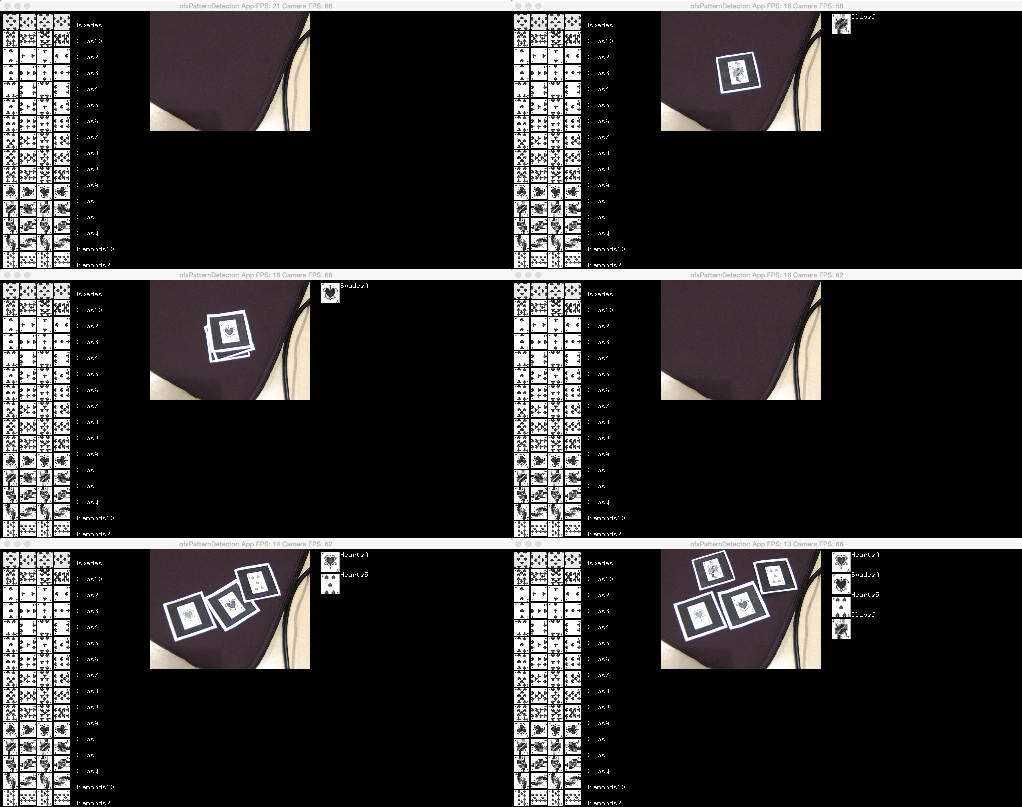
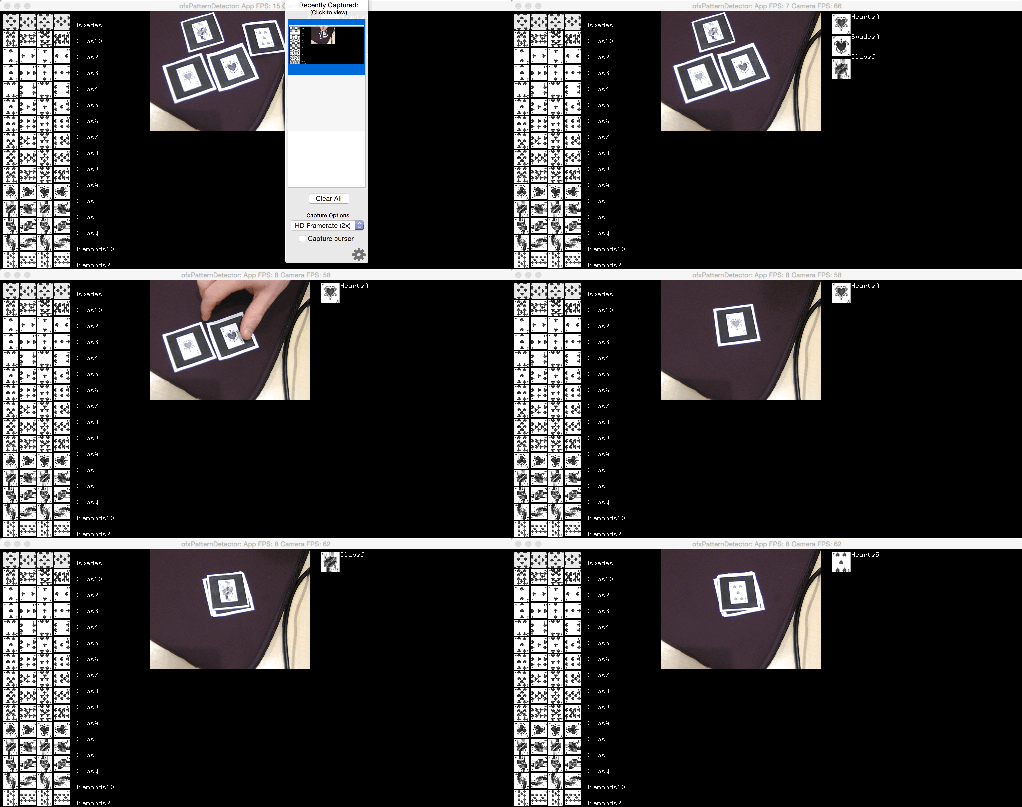
The potential down-sides of image recognition is that the system is very sensitive to differing light levels, but we propose to create a reliable lighting state by mounting a downward pointing lamp next to the camera above the card table to eliminate this issue.
The positives for our purposes are that the camera and system together behave more like the human eye – the camera sees the card on the top of the pile, and will be programmed to respond to that by triggering a sound. We will also be able to use a standard cheap card deck, rather than having to make or have manufactured a special card deck with RFID tags inserted.
There’s a lot more still to discover and test before we build the final system. Then there will be lots more testing! We’ll then build all of this into a specially constructed card table, which will conceal all the technology hardware, keeping the interface as close to the experience of a ‘normal’ card game as possible.

March 18, 2015 by katie
Some discussions with the show’s writer Clare Duffy helped to clarify our intentions for this re-worked scene: how we want the characters to be read; how we want the audience to feel; where the scene needs to get us to by the end.
Now we needed to find or create a suitable game mechanic to shape the audience’s interaction with the soundscape. I called on the services of games designer, and general genius, Holly Gramazio, to help us work out an elegant solution.
I was keen, if we could achieve it, that the interaction was actually the playing of a game, rather than an interaction that was essentially like pressing some buttons in a pre-defined or random sequence, which would likely be less satisfying.
Holly, David Haylock and myself spent an intense day of card-game-playing at the Pervasive Media Studio (its a tough job, but someone’s go to do it), trying out multiple types of existing and newly made-up card games. Holly’s inventive powers were put to good effect, and we came out of the day with the rough outlines of three possible options for games – each with a very different game mechanic. All three games were themed around the shape of a clock face (to tie in with our body clock theme), the first: a type of snap, the second: a simple betting game, and the third: a collaborative solitaire.
After some play-testing with friends and colleagues to test how enjoyable and easy to play each game was, and discussions with Clare the writer about which game type would fit best with the scene’s dramaturgy, I chose the collaborative solitaire.
It wasn’t the most enjoyable of the games, but game-play got easier as the game went on allowing players more ‘brain-space’ to listen to the soundscape that playing the game will trigger. It was also collaborative, rather than competitive, which seemed right as the two pairs who have been experiencing the show separately until this point, and may be strangers to each other, will join up in this scene and remain together until the end of the show. So building something together seemed preferable than potentially introducing friction that wasn’t helpful in terms of watching the rest of the show. It also fitted dramaturgically, as the players would be piecing together a picture of a clock face, card by card, whilst listening to sounds and snippets of overheard conversation that will piece together and illuminate previously concealed elements of the narrative.
by katie
I’ve been working towards bringing Black Tonic back almost since we finished the first run of shows back in 2009. That’s one of the reasons I’m so excited that we’ve finally made that happen in 2015.
As the years ticked by, and I gained some critical distance from the original production, something became clear to me. In our haste to get the show ready during the initial devising and rehearsal period, coupled with a lack of technical knowledge and very limited resources, we had failed to do justice to our original concept for the pivotal scene in the show – known to us as ‘Jo’s Room’.
The ‘Jo’s Room’ scene is where we take the audience to the dark (literally) heart of the show. We introduce them to ‘Jo’, a blind, card-playing criminal. In the original production ‘Jo’ was ably personified by an older male actor, and the scene was engaging, weird, and atmospheric. But I felt that we’d lost the metaphysical aspect of the character by having him physically there. He is our ‘Wizard of Oz’, and pulling back the curtain to reveal him there in his human size felt like a bit of an anticlimax.
You see, for us, ‘Jo’ is a blind-seer (in the manner of Tiresias from Greek myth), he ‘sees’ everything that happens in the hotel. He is profoundly blind and perceives no light, and therefore suffers from a genuine medical condition known as ‘free-running’ where his body clock drifts out of sync with the 24 hour clock by a few minutes every day until midday feels like midnight, and continues like this in an eternal loop. He also represents for us the ‘anti-hotel’: chaos, disorder, timelessness. Where the hotel is ordered, timetabled, obsessive-compulsive.
For the remount of Black Tonic in 2015 I wanted to re-design this scene to better communicate our character ‘Jo’. The way we’ve chosen to do this is to remove the live actor from the scene, and to invite our audience to inhabit Jo’s room in a way that allows them to almost ‘become’ Jo for the duration of the scene.
We are inviting the four audience members to play a game of cards together on a magic card table, where the laying down of a card allows us to listen in on a bedroom in the hotel and what is currently happening in there. As the game unfolds the audience members build a (sound) picture of the hotel, putting them in Jo’s shoes, so to speak.
We are lucky enough to be collaborating with Watershed in Bristol on the re-development of this scene, and are working with their Creative Technologist David Haylock to make this idea a reality.

by katie
Ahead of our 2015 re-tour of Black Tonic, we are taking the opportunity to polish, improve, and even completely re-make parts of the show to make it the best it can be for this new tour.
This blog series will chart the creative development process, and hopefully provide an insight into how a show like this gets made.
You can find all the blogs in this series here: Play Your Cards
